Saturday, June 29, 2019

Surprise in design


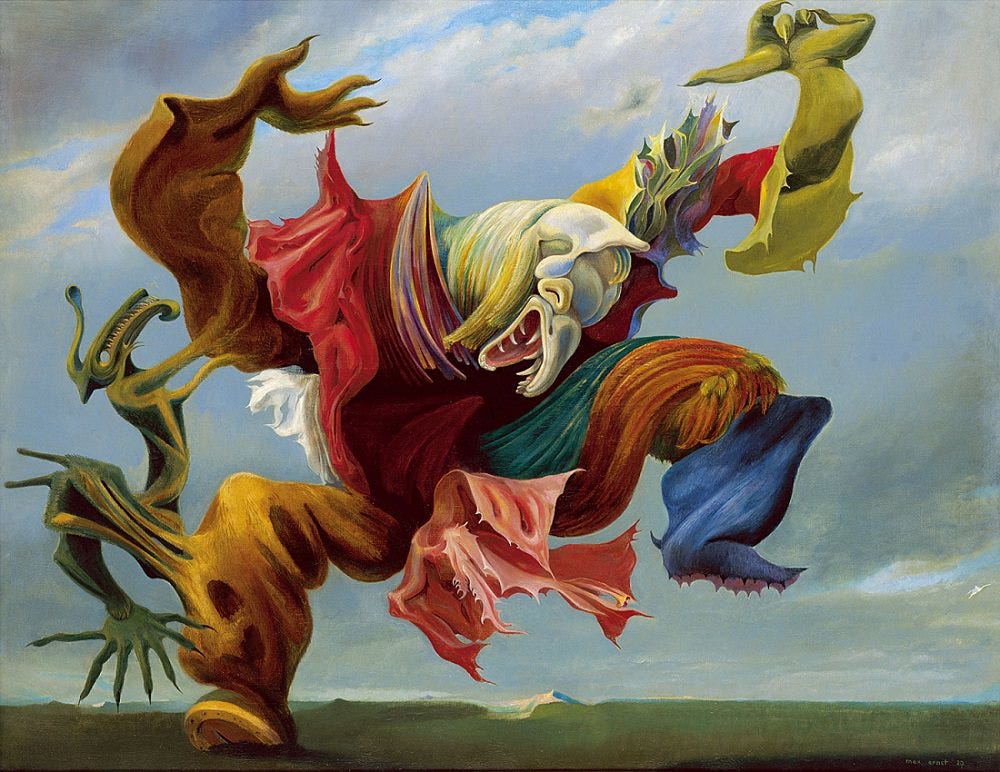
Image result for surrealism
Design works outside science. Science is a useful tool, just like language is a useful tool. But science is based on assumptions of rationality and empirically driven truths that can be drawn from the apparent chaos in which we live. Design embraces chaos and extracts features from it that appeal to humans.

We can use qualitative methods, such as ethnography, and artistic insights to create product appeal to groups different than ourselves. Research requires an articulated framework describing an understanding of how the world works and how you can learn about how it works. It should (but rarely does outside of dissertations) require a positionality statement also because your position with respect to data influences acquisition methods and interpretation, among other things. 

As a Christian, I don’t follow “methodological naturalism” as a guide, I believe in God’s personal involvement. However methodological naturalism can’t handle the notion of irrationality. It has a faith component, namely that the human mind is rational and the world has "closed regularities", meaning that there are no exceptions to scientific laws.

The words art, design, and craft have specific meanings. Design can mean a purposeful development of a functional product. Industrial design also considers the artistic influences that create appeal beyond the functional. Industrial design embraces ethnographic methods that aid in designing things appropriate for people who are different than the designer.

Designing things in the tradition of industrial design, taps into both functional (mechanistic) and “non-functional” (non-mechanistic) elements. But the non-functional elements in particular, can be rooted in faith and worldview issues. The non-functional elements are where art flows into design, and this can involve surprise.

I love surprise in design, it has delightfully irrational elements that derive from outside of the weight of science. Pleasant surprise is a beautiful element in design.


Thursday, June 13, 2019

Air Force One Livery Design


The history of the United States' “Air Force One” is interesting. It involved a famous industrial designer and very personal choices by the John and Jackie Kennedy. Raymond Loewy made two visits with John Kennedy and they worked out the ideas with "crayons and cutting up paper." Here is an account taken from the New England Historical Society:


Then Loewy visited the National Archives to examine historic documents. He was struck by the first printed copy of the Declaration of Independence, it had the new country's name set widely spaced in capital letters in a typeface known as Caslon.

Kennedy had already ordered the Air Force to remove the military lettering in favor of the simple United States of America.  And he told Loewy he liked blue.
Loewy chose two blues: slate and cyan. He left the underside of the fuselage silver and added the presidential seal near the nose, a large American flag to the tail, and the words "United States of America" in capital letters using the Caslon typeface.

The First Lady had a hand in designing the interior of the plane. She made sure the president had his own entrance, a customized bed, a stateroom, a conference room, glassware from Tiffany’s and a pale blue rug with an American eagle in the center of an oval with 13 stars.

Loewy's 1962 drawing
(Source: https://www.moma.org/collection/works/196025)


Thursday, May 30, 2019

Design is stressful!


This is an excerpt from the epilogue of my newest book:"Intense Design: Product Design Lessons From Cold War Era Skunk Works"

Design is stressful. You don’t have a clear path to success. Your stomach churns because your design seems to rely more on gut instinct and desperate assumptions than on things you can explain mathematically. Most painfully, you think you haven’t found “the great idea.” You wonder what you haven’t done correctly and what you have missed.


On top of this angst is our ego. It follows us and taunts us. We want to say “This is my design,” when in reality, 99 percent is existing stuff that you rearranged. You want to develop a great design, but you realize your work is in response to someone else’s insight into the need for your design in the first place. Your idea did not fall into a valley of awaiting desire, but was sculpted from rock laid before you by others.


I have lost sleep and dealt with a lot of angst in the process of design. Personally, I battle with:

1) worrying about missing the best design solution and 

2) subordinating my ego to the design.


I want to believe there is some ideal design, and I want to keep the creative process going until I arrive at this ideal. The ideal design doesn’t seem to be the case as I look at the man-made world around me. All designs are ephemeral, replaced in good time by designs more suitable for the day. I have had technically sophisticated designs get completely replaced by a new technology. I’ve had embarrassingly simple designs that have lasted for decades. Basic forms and functions already exist in nature, from geometric forms in crystals to round trees rolling down hills. Designers more often than not are manipulating what already exists. However, we tend toward perfectionism and strive to create the perfect design. Because our identity is in design, we wish to separate ourselves from the “amateurs” and dazzle the world with our ability. We can get some peace in knowing that our design is not the ending point, but one of many points in a galaxy of evolving ideas. Is there a perfect poem or painting? If so, has it been read or observed, or does it live in an artist’s mind, never to be degraded by actual execution on paper or canvas?


This leads into the problem with ego. Pride is a fundamental fight. We want our mark on the world because we believe we have something distinctive to contribute (and we do!). We don’t want to be someone who shovels coal all day with nothing to show for our labors but a pile of coal. We want to create. We were meant to be creators. We identify ourselves as such, and strive to execute this desire in our profession. Therefore, we want all our professional work to start with “let me show you my design.” However, we work in a collaborative community with an intellectual ecology, whether across time or contemporaneously. We wonder if we are a singular sensation like the Slinkey and Salinger, or copious creators like King and Kandinsky.


See the book at: 


Monday, May 27, 2019


Engineering for Industrial Designers and Inventors made it to the Best Product Design Books of All Time

BookAuthority Best Product Design Books of All Time
I'm happy to announce that my book, "Engineering for Industrial Designers and Inventors: Fundamentals for Designers of Wonderful Things", made it to BookAuthority's Best Product Design Books of All Time:
https://bookauthority.org/books/best-product-design-books?t=cnz1vz&s=award&book=1491932619

Saturday, May 25, 2019

STEAM Education Hurts Art


Leave art alone. Why has art gotten drawn into STEM education, producing the cute acronym STEAM? Is art the decorative box that you put technology into? Have artists devolved to stylists?

The problem with STEAM is that art is pulled in as an afterthought, it is anchored to something not of its own making.

Art is often connected to technology, whether paint pigments or casting processes. However, art should not be constrained by these technical matters. Art merely uses the tools of technology. Technology shouldn’t use art.

Every year, my students and I make and launch rockets. The science is pretty simple: make everything aerodynamic and keep the center of pressure behind the center of gravity. There is no math. It is a lot of fun and it is always magical to touch the sky with rockets. However, it is not really STEM education. It is building stuff and having fun.

Launching a rocket or flying a drone is not STEM education, it is using technology. The acronym STEM is problematic in that it gives equal value to all subjects and suggests a sequential movement that is wrong. One must first understand math and science before moving to engineering and finally technology. Using technology has nothing to do with understanding the science and math that undergird it. It is unwise to equally couple the easier insights of using technology with the more difficult challenges of understanding science and math.

Technology is more important than science and math for most of us. We want X-ray technicians to be expert practitioners on safely operating X-ray machines. We don’t care if they know calculus or physics. But our educational system is locked into developing structured, theoretical foundations for professions.

Interdisciplinary study is good but we should study MSET and A instead of STEAM. Maybe MSET&A education is too hard to pronounce, let’s call it design education and move on.

And one more thing…

While it is easier to define what art is not, the Oxford English Dictionary commonly uses terms such as creative expression, beauty and emotional power. However, non artistic expressions can be creative, non artistic expressions can be beautiful.


One of the OED’s actual definitions is:

The expression or application of human creative skill and imagination, typically in a visual form such as painting or sculpture, producing works to be appreciated primarily for their beauty or emotional power. https://en.oxforddictionaries.com/definition/art


Rocket party: STEM-like activity but actually model building and fun.
Painting party: Art with nothing to do with STEM.

Birds nest: I took this photo in my yard today. Is the bird an artist?

Saturday, March 30, 2019

Cult of Efficiency


Efficiency

We lust after it. We now have a handful of people defining the experience of many on social media platforms. Reddit has less than 500 paid employees (but thousands of volunteers.) Other platforms also have small, giggling gaggles of employees defining the user experience.

Coders create the environment where technology devotees live. For the sake of efficiency, we cede our information curation to a handful of coders. Voice AI offers only one verbal response. Efficient but scary.

Efficiency and autonomy seem to battle. When ostensibly wise coders and AI prompt recommended language and succinct answers, we forfeit something – but it isn’t our time. We seem to gain time with this added “efficiency”. But we must recognize that language is also a technology too and does not provide some absolute freedom of expression.

We are also overwhelmed with information. Although we ask AI and the coders behind it to ease our environment, the cascading flow of bad news in front of our eyes makes us assuage our guilt by claiming some type of victim status.

Therefore we sometimes need to take a walk in the woods and draw something with a pencil. We need to use our extra time wisely. Maybe efficiency needs to be redefined. I basically never proof read emails or messages, I trust Google with my information curation, I sometimes used recommended responses on texts. I have been sucked into the lust of efficiency. I love it. I can get so much done so quickly.


Rambling words don’t counter my tendency towards using the highest efficiency systems possible. I look at every physical and virtual system and think about optimizing its efficiency. I can’t help myself. But I observe the danger of efficiency and try to design wonderful things with my free time. Sometimes I just watch YouTube “how it’s made” videos and eat chocolate too. C’est la vie. 

Friday, November 9, 2018

Humility in Design


Boats amaze me.

Borders dissolve and dreams arise as they take you where you want to go. Boats have personality and character infused by those that design and build them. Living in Pennsylvania, it is interesting to look at our namesake Navy ship, the troublesome, original USS Pennsylvania. She was the largest sailing warship built in the US.

She was started in 1816 and finished 21 years later in 1837. Almost...  Over the protests of the locals, she felt the ocean swell briefly as she sailed out of her namesake state on her way to Norfolk, Virginia. There she was dry docked so the hull could be covered in marine growth resistant copper.

The USS Pennsylvania was a huge ship for her time, with four rows of gun decks carrying up to 136 guns. She was 210 feet long, with three masts and a displacement of 3,241 tons. It took a huge crew of over a thousand to operate her.

She was considered by some “the pride of the Navy and the honor of our Union” but was awash in political intrigue and criticism for her expense, antiquity, and lack of purpose. It was a project that would not die. Finally, she was burned at the onset of the Civil War in April 1861 to prevent her use by the Confederacy. A sad life for a great ship.

The USS Pennsylvania acted as a floating barracks for most of her short life, much like the ship pictured above.

Imagine the designers and builders who infused her with their talent, sweat and bruised knuckles. This was a great project to show off to family and friends. Something bigger than themselves. Something that could inspire others. However, it never amounted to anything important. It was basically a jobs program. Another humbling lessons for me as I flounder about pursuing greatness.


My son in his boat, built from what was laying around this pond. A great design and build project, letting him go where he wanted!


A vain photograph of my wife and I with our charter boat, which I neither designed nor built.