Showing posts with label industrial design. Show all posts

Saturday, March 9, 2024

Usefulness: Cheap Art and Authenticity


Forty dollars for a framed painting? Sixty-five dollars for a hand knit sweater? This is what people charge when they seek usefulness over income. When they enjoy commerce over wealth, when they seek satisfaction over sustainability. 

I was visiting an affluent retirement community where I attended an arts and craft festival. The artists and crafters were talented and had a voice to share. They didn't want their work stacked up in a dusty basement. They wanted others to enjoy their work, their art, their voice. But they wanted a small affirmation of value. They wanted commerce, an exchange of money for their hard work and well-seasoned talent. The pricing did not represent true value, but for me, the pricing was shouting, My work has value! I don't need the money, I just want appreciative homes.

The need for purpose, when money isn’t important, appears in our desire to create.

When branded art becomes excessively valuable, when AI handles the landscapes and portraits, we still seek authenticity. Authenticity is art now. The rules of composition, the use of allegory, and the extension of famous artists’ oeuvre can be managed by generative AI. But art that is authentic will have a home. It will be squeezed between the mass-produced AI generated decorative arts and the wares of lesser talented artists. Authenticity and the human connection between the artist and the viewer will be interesting to watch over these next years. The critics and authenticators might only be asking, Where are the surprises? Where are the mistakes?


Monday, May 8, 2023

Death of Ideation Sketching


Most of my ideation "sketches" just flow through my mind--little maquettes dancing with flashes of imagery. Requiring a specific number of ideation sketches, never lifting your pen, working with two colors—these are all fine to the extent they are useful.* However, design educators should not be pedantic about these things.

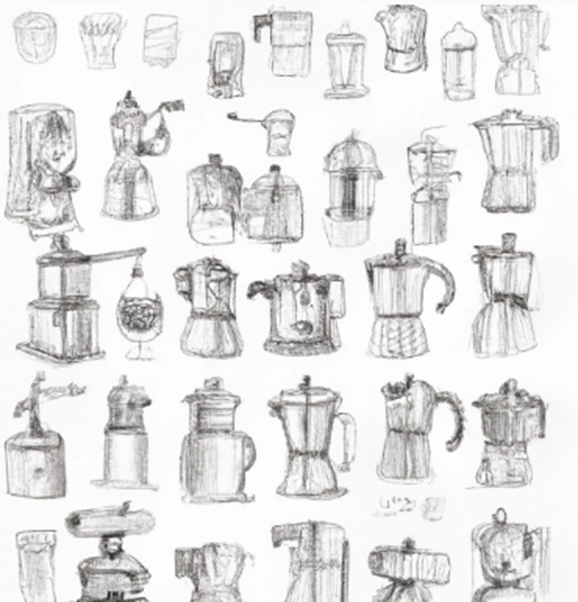
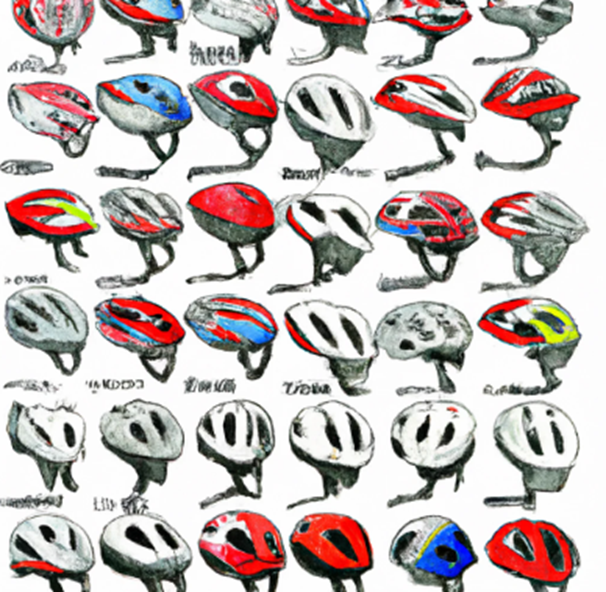
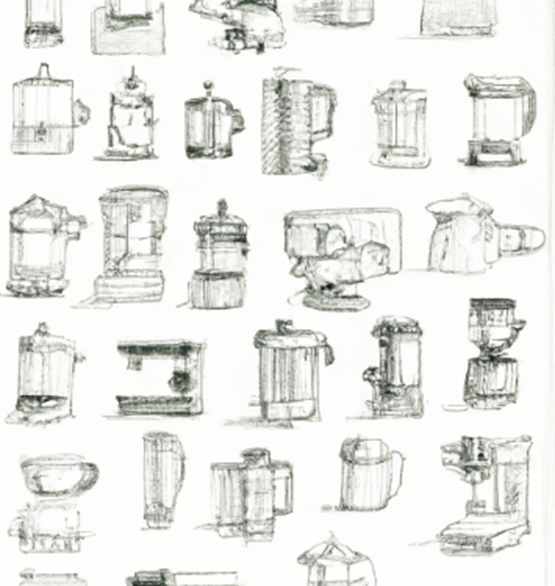
In a few minutes I littered the blog above and below with ideation sketches using DALL-E 2. This will only get easier and “better” with time. These sketches of toasters, helmets, blenders, coffee makers, and door handles may not be to your liking, but I generated all of them in less than ten minutes of typing. They are done in marker, colored pencil, and graphite. Easy stuff.

Interesting issues arise for the designer/educator/student to consider in the AI universe. One of them is personal style. While our personal style seems independent of AI’s ability to identify patterns that nurture rule creation, it is influenced by the world we encounter, much of which will be increasingly generated by AI or flattened by the globalization of cultural standards.

Unlike AI, people have the ability to 1) change their style and 2) incorporate influences serendipitously. The randomness and mistakes people make do not rest in the datasets that machine learning requires. Moreover, people respond and appreciate the sacrificial time expended by other people. People hold hands and converse. AI can converse, but it doesn’t sacrifice its time in the process.

What is personal style and how much of it is simply a product of cultural imputation and the copying of influencers? Do we own our own sense of style? These are unanswerable questions; however, people can take surprising actions that upset rule-based approaches. People have the ability to shed rules and explore new ways of thinking and acting. Additionally, people can be exposed to events that modifies their personal style. This serendipitous stumbling can lead to a surprising randomness in style.

I do take joy knowing that imagination is greater than knowledge, imagination is an untethered rocket and a sweeping cool wind that carries thoughts wherever it will!  Maybe my technology-enabled works are only decorative, but I own them. They are my voice. Being able to present my voice is all I can ask. I can’t ask for fame or money, no one owes me that.

In this next chapter of design, the dogma should continue to crumble and distinctive human abilities should shine brighter while we swim in what AI is flooding at our feet.

The most beautiful emotion we can experience is the mysterious. It is the fundamental emotion that stands at the Cradle of all true art and science. Key to whom this emotion is a stranger, who can no longer Wonder at stand wrapped in awe, is as good as dead, a snuffed-out candle. Albert Einstein 1930


* I like tradition. My students and I have crawled into a dark room under one of our campus buildings to do blind contour drawings. Weird and intriguing, but I really don't know how useful it is for the aspiring designer.

More ideation sketches! How many do you want? I have a few more minutes.


All images are from Dall-E 2 (and I)


Wednesday, November 3, 2021

Boat Design: Mechanistic and Non-mechanistic Influences


This is an extract from my latest book, Wooden Wonders: Traditional Malaysian Fishing Boats

The presentation of design influences on boats is best introduced by placing it in the context of what ancient philosophers asserted were the three motivators of all human inquiry: pursuit of truth, beauty and goodness. This triumvirate of cognition, aesthetics, and morality offers a framework for looking at traditional design as an attempt to 1) develop a boat that will be safe, durable and functional, 2) express cultural heritage and historicity, 3) incorporate belief systems, and 4) express an aesthetic quality. The first category can be referred to as mechanistic influences and the other categories can be referred to as non-mechanistic influences.

By design, boats place people far out on the water in an unnatural and hazardous environment. Therefore, boats are conservative in their design and often enshrouded by ritual and symbolic elements derived from belief systems. If one is to have faith in a boat when at sea, it seems natural to want to imbue the craft with as much safety as possible, both physical and spiritual. Horridge (1995) notes:

Because the use of them is dangerous, boats are particularly conservative structures and all cultures adhere to their own proven designs. Rigs are more easily copied than hull structures. When changes in design are introduced they are not admitted. In consequence, boatbuilding techniques may survive unchanged for 1000 years or may be quickly modified in a single generation as happens when designs are transferred from elsewhere.

Indigenous boat design knowledge can derive from traditional influences that lie outside the realm of naval architecture. This indigenous knowledge can consider available construction materials and fasteners as well as specific boat applications. This knowledge also leads to design details that affect performance and safety. When asked to explain specifics about a design, traditional builders may respond in a generic fashion, indicating there is no other way to design the boat or the design gives better performance. Construction details have been relayed from their ancestors and deviations from this tradition are considered dangerous (Horridge, 1995).

The details of the boat are ostensibly designed in response to a particular need. For example, the sharp bow allows a boat to pierce waves, a shallow draft allows passage over sandbars and an open transom allows nets to be easily pulled onboard. The overall boat design is dictated by needs for stability, buoyancy, maneuverability, seakindliness, draft restrictions, superstructure, and equipment requirements. However, in addition to these mechanistic elements, boat designs also derive from traditional designs, traditional construction methods, and available materials. In addition to these traditional influences, boat design is influenced by perceptions regarding durability, safety, comfort, and maintenance.

Boat designers make judgments as they contend with many conflicting design issues such as performance versus aesthetics, stability versus capacity, comfort versus seakeeping, safety versus speed, safety versus ease of use, hull size versus operating cost, and fuel efficiency versus production cost. The following sections describe a few important mechanistic factors that may be helpful in considering the photographs and data that follow.


 [o1]Remain as non-italic & bold.


Tuesday, November 2, 2021

Closing Thoughts from "Traditional Malaysian Fishing Boats"


This is an extract from my latest book, Wooden Wonders: Traditional Malaysian Fishing Boats

One quickly becomes defined by one’s discipline as we witness the academic, professional, and even legal walls constructed around disciplines. However, these walls can create an insidious environment where the physical sciences are honored while everything else becomes noise. I have a deep affection for the mysteries revealed by science, but I recognize the physical and life sciences have waded into matters that require involvement beyond science.

Science can also give an incomplete picture of truth. Philosophers have investigated the limits of the scientific method, but science can be blind to the broad swath of culture and therefore fails to provide all data and guidance for culturally appropriate designs. For me to make sense of the value of non-mechanistic design elements I needed to recognize the intangible, scientifically unapproachable aspects of these design elements. Not all questions are scientifically answerable and some can only be judged based on their value to the individual.

Fishing boats are an important part of the cultural heritage of Malaysia. Their role in commerce will necessarily change in response to the dynamic forces applied to the Malaysian society. These boats provide food and livelihood for many. They are designed with care, built with integrity, and reflect the pride and dignity of their builders. This consideration of traditional Malaysian fishing boats was not intended as a nostalgic reflection but rather an investigation of the gritty, every day issues of boat builders and fishermen. These men were motivated by market forces even if they did sense the twilight years of their work. The builders and fishermen I visited were not striving to be curators of old technology, they were living their lives with the mixture of dreams and practical resolve that motivates us all in our labors.


Tuesday, October 12, 2021

Wooden Wonders: Traditional Malaysian Fishing Boats


I had the pleasure of discussing my work with traditional Malaysian fishing boats and my book, "Wooden Wonders" yesterday. You can watch the presentation at:

https://www.youtube.com/watch?v=Hwv23DiaJMY


Thursday, May 27, 2021

Adventure Democratized – by design


Navigating on the water has become remarkably like playing a video game. You keep your digital boat image in the digital white area of a digital map. I have been sailing many decades and remember the old days of boat navigation. These were bad old days. You were more tense. You would determine your position as best you could and plot a direction that was safe to travel. You would do this with a paper chart (map) and parallel rulers. You would determine a range of directions (bearings) that were acceptable and those that weren’t. You considered current (and leeward movement for sailboats) and try to offset these invisible movements. If you could see visible markers, such as buoys, you were in pretty good shape although the current and leeway could deceive you. When you could see two navigational markers you could precisely locate your position and that was thrilling. Otherwise, you were not exactly sure of where you were. Your depth sounder gave you some idea of what was going on but it could not be fully trusted in silty waters. You struggled with how fast to go when things got tight. Running aground at anything but dead slow is a big problem. Sextant sightings were fine in the open ocean but not around hazards.


I don’t miss the tension of analog piloting. It was a challenge and had some visceral thrill (we are going to run aground!) You were still dependent on technology, but it was charts and navigational aids. This is not much nobler than GPS and electronic charts. However, I guess you are more prepared for power outages and digital deaths. I also know high speed Morse Code, having been a ham radio operator for many decades. However, this ability has not helped in any way for the last few decades. It is a little sad when your skills are no longer important, but that is how life goes. Don’t love anything that won’t love you back.

I recently finished Dana’s, “Two Years Before the Mast” which recounts a trip from the US East Coast, around Cape Horn and up to California. It was a more interesting read than I expected. Now you can view California’s nature on YouTube. When Dana was traveling in the 1830s, you might have to wait a week in the raging seas to get a wind shift so you could actually get around Cape Horn. Losing your ship for any reason meant you were likely to die or at least be stranded. The saddest part of sea life at that time is the men were stuck in their position. They had little hope for anything better. I can’t imagine not having hope. Hope is fueled by wonder and in turn fuels ambition and action. Losing hope takes away a deep part of human essence. 

Secret knowledge closes doors. Modern navigation turned my old skills into nearly useless relics, but reducing the stress of boat navigation is a sweet change and makes boating more accessible to everyone – adventure democratized by design. Navigation is a small example of the doors opened by design and technology. Designing both technology and its integration into purposeful systems has allowed people to do wonderful things, from visually hopping on their drones to accessing the world’s greatest library on the internet. 

I don’t know if “purposeful systems” is a real term, but I like it. Only humans can have a purposeful vision that brings technology together by design. Adventure democratized reminds me of rock climbing, kayaking, and backpacking. These are some of the inexpensive ways to gain access to nature’s wonders, but that is another story…. 


Thursday, May 6, 2021

Social Anxiety in Design


The public nature of design critiques used in education may adversely quiet gentile voices. Those with social anxiety are overwhelmed by this affront to their propriety and sense of peace. Does public scrutiny and pointed criticism help one become a better designer? Well, yes. Is it required to make you a better designer? No, not necessarily.

Public critiques can have a homogenizing affect as we try to communally agree on what is good and bad design. The intrusion of AI makes this effect broader as we move from friends and classmate’s opinions to some algorithm rooted in established data or normalized rules.

Almost all of my work has been improved by the critique of others. However, there are categories of my work in which I don’t want critiques. I want only to be a songbird in the forest.

Thursday, February 4, 2021

Contending with Complex Interdisciplinary Problems using Affinity Congregates


Many innovations come from those in marginal positions in a discipline, and these individuals therefore greatly benefit from the support afforded by like-minded people. James Watson, co-discoverer of the double helix nature of DNA, stated the power of collaboration unequivocally: “Nothing new that is really interesting comes without collaboration”. However, in some groups a dominating person might drive ideation. As discussed previously, group dynamics need to be recognized in group settings. Particularly in the case of new groups, such as in a classroom setting, an affinity congregate allows people to individually express their ideas before becoming engaged in a group situation. This is a small variation of affinity diagraming because affinity congregating focuses on initial, independent problem solving before bringing ideas to a group so that participants may collectively identify affinities. Affinity congregation preserves the independent voice of each student. This approach is intended to prevent group dynamics from taking over the ideation process.

With affinity congregating, the participants are presented with a problem or design prompt, they individually write solutions on a sticky notes or other suitable media. When they are finished writing proposed solutions, the notes are collected and assembled by a moderator and grouped by affinities or themes into an affinity diagram. The themes arise from the data, which is founded on grounded theory. Grounded theory is a method common in the social sciences that allows categories and concepts to develop based exclusively on data and not from predisposed theories.

While these affinity congregations shown by the groupings of notes is subjective, general themes or affinities arise in a logical fashion. A variation of this approach is to have the group identify themes rather than a moderator. In this approach, the group gathers around the notes and identifies logical groupings. The notes are reviewed and duplicate ideas are stacked on top of each other. Finally, the affinities can be discussed and each idea can be critiqued by the group.

Affinity Congregating Technique Summary

1. Problem statement or design prompt.

2. Individuals write proposed solutions on sticky notes.

3. Moderator collects notes and assembles by affinities or themes that arise (affinity diagrams). Alternatively, the group identifies affinities as a team.

4. Duplicates omitted.

5. Group critiques affinities and proposed solutions.

Outcomes of Affinity Congregation

One example of applying this technique to professional practice is addressing the issue of palliative care in the developing world. In this case, I invited two physician colleagues to partner with this investigation. Because we came from different disciplines (design, pain management and palliative care), the congregation technique was used to prevent the board-certified palliative care specialist from overwhelming the pain management expert and the engineer. This cooperation led to identifying four tracks of palliative care: physical, psychological, relational, and spiritual as shown in Figure 4. These tracks were further divided into key concerns and we developed practical treatment options.

In this example, the most common concerns were identified as pain, dyspnea (air hunger), nausea and vomiting, delirium, anxiety, and terminal secretions (‘the death rattle’). The affinity aggregation allowed artificial intelligence driven diagnosis systems to inhabit an equal space as recommending paracetamol or diclofenac for pain relief. This technique worked well in this interdisciplinary environment because we concluded with specific recommendations as well as the somewhat surprising result that the patient care should be the responsibility of a loving caregiver rather than a medical professional.


Figure 4 – Integrative palliative care factors.

From:  T. Ask, “Engaging Creativity: Classroom Exercises for Enhancing Engineering Students' Creative Self Identity,” 2019 ASEE Zone I Conference & Workshop, Niagara Falls, NY, USA, April 2019, https://peer.asee.org/33791.

And     T. E. Ask, J. Boll and A. Nesbitt, “Steps towards Integrative Palliative Care in the Developing World,” Design for All Institute of India, Newsletter Vol. 12, No. 3, p. 61, 2017.


Monday, July 27, 2020

What about my dioxin footprint?


Carbon footprint has become a simplistic tagline for environmental impact. This term seems to discount concerns for profoundly hazardous chemicals. There are 187 hazardous air pollutants, that in the US, are controlled by the EPA. I have them listed at the bottom.

These pollutants can cause things such as cancer, birth defects, impaired lung function, and reduced fertility. They can also cause harm to the nervous system, cardiovascular, and brain.
I worry more about mercury and dioxin footprint than carbon footprint. I think the old-fashioned word “pollution” is better than “carbon footprint”. Everyone concerned with the environment should understand the notion of embodied energy, which considers the energy (and pollution) associated with a product, including things we don’t think about, such as mining, transportation, administration, disposal, etc.

Bad products that are expensive and then soon discarded always have a high embodied energy. Recycling has environmental impact, which is why reducing consumption is at the top of the “reduce, reuse, recycle” mantra. Likewise, sequestering carbon artificially is not environmentally neutral – I’m a big fan of living trees for obvious reasons!

Personally, I think fine particulates (e.g., PM2.5) are the biggest immediate pollution concern. It is very sad to watch children running around outside enjoying the use of their healthy lungs and bodies while breathing all the nasty particulates in which we immerse them.

What level of sophistication is required by people that regulate us?


EPA’s Current List of Air Toxics

Acetaldehyde
Acetamide
Acetonitrile
Acetophenone
2-Acetylaminofluorene
Acrolein
Acrylamide
Acrylic acid
Acrylonitrile
Allyl chloride
4-Aminobiphenyl
Aniline
o-Anisidine
Asbestos
Benzene (including benzene from gasoline)
Benzidine
Benzotrichloride
Benzyl chloride
Biphenyl
Bis(2-ethylhexyl)phthalate (DEHP)
Bis(chloromethyl)ether
Bromoform
1,3-Butadiene
Calcium cyanamide
Caprolactam
Captan
Carbaryl
Carbon disulfide
Carbon tetrachloride
Carbonyl sulfide
Catechol
Chloramben
Chlordane
Chlorine
Chloroacetic acid
2-Chloroacetophenone
Chlorobenzene
Chlorobenzilate
Chloroform
Chloromethyl methyl ether
Chloroprene
Cresols/Cresylic acid (isomers and mixture)
o-Cresol
m-Cresol
p-Cresol
Cumene
2,4-D, salts and esters
DDE
Diazomethane
Dibenzofurans
1,2-Dibromo-3-chloropropane
Dibutylphthalate
1,4-Dichlorobenzene(p)
3,3-Dichlorobenzidene
Dichloroethyl ether (Bis(2-chloroethyl)ether)
1,3-Dichloropropene
Dichlorvos
Diethanolamine
N,N-Dimethylaniline
Diethyl sulfate
3,3-Dimethoxybenzidine
Dimethyl aminoazobenzene
3,3'-Dimethyl benzidine
Dimethyl carbamoyl chloride
Dimethyl formamide
1,1-Dimethyl hydrazine
Dimethyl phthalate
Dimethyl sulfate
4,6-Dinitro-o-cresol, and salts
2,4-Dinitrophenol
2,4-Dinitrotoluene
1,4-Dioxane (1,4-Diethyleneoxide)
1,2-Diphenylhydrazine
Epichlorohydrin (l-Chloro-2,3-epoxypropane)
1,2-Epoxybutane
Ethyl acrylate
Ethyl benzene
Ethyl carbamate (Urethane)
Ethyl chloride (Chloroethane)
Ethylene dibromide (Dibromoethane)
Ethylene dichloride (1,2-Dichloroethane)
Ethylene glycol
Ethylene imine (Aziridine)
Ethylene oxide
Ethylene thiourea
Ethylidene dichloride (1,1-Dichloroethane)
Formaldehyde
Heptachlor
Hexachlorobenzene
Hexachlorobutadiene
Hexachlorocyclopentadiene
Hexachloroethane
Hexamethylene-1,6-diisocyanate
Hexamethylphosphoramide
Hexane
Hydrazine
Hydrochloric acid
Hydrogen fluoride (Hydrofluoric acid)
Hydrogen sulfide
Hydroquinone
Isophorone
Lindane (all isomers)
Maleic anhydride
Methanol
Methoxychlor
Methyl bromide (Bromomethane)
Methyl chloride (Chloromethane)
Methyl chloroform (1,1,1-Trichloroethane)
Methyl ethyl ketone (2-Butanone)
Methyl hydrazine
Methyl iodide (Iodomethane)
Methyl isobutyl ketone (Hexone)
Methyl isocyanate
Methyl methacrylate
Methyl tert butyl ether
4,4-Methylene bis(2-chloroaniline)
Methylene chloride (Dichloromethane)
Methylene diphenyl diisocyanate (MDI)
4,4'-Methylenedianiline
Naphthalene
Nitrobenzene
4-Nitrobiphenyl
4-Nitrophenol
2-Nitropropane
N-Nitroso-N-methylurea
N-Nitrosodimethylamine
N-Nitrosomorpholine
Parathion
Pentachloronitrobenzene (Quintobenzene)
Pentachlorophenol
Phenol
p-Phenylenediamine
Phosgene
Phosphine
Phosphorus
Phthalic anhydride
Polychlorinated biphenyls (Aroclors)
1,3-Propane sultone
beta-Propiolactone
Propionaldehyde
Propoxur (Baygon)
Propylene dichloride (1,2-Dichloropropane)
Propylene oxide
1,2-Propylenimine (2-Methyl aziridine)
Quinoline
Quinone
Styrene
Styrene oxide
2,3,7,8-Tetrachlorodibenzo-p-dioxin
1,1,2,2-Tetrachloroethane
Tetrachloroethylene (Perchloroethylene)
Titanium tetrachloride
Toluene
2,4-Toluene diamine
2,4-Toluene diisocyanate
o-Toluidine
Toxaphene (chlorinated camphene)
1,2,4-Trichlorobenzene
1,1,2-Trichloroethane
Trichloroethylene
2,4,5-Trichlorophenol
2,4,6-Trichlorophenol
Triethylamine
Trifluralin
2,2,4-Trimethylpentane
Vinyl acetate
Vinyl bromide
Vinyl chloride
Vinylidene chloride (1,1-Dichloroethylene)
Xylenes (isomers and mixture)
o-Xylenes
m-Xylenes
p-Xylenes
Antimony Compounds
Arsenic Compounds (inorganic including arsine)
Beryllium Compounds
Cadmium Compounds
Chromium Compounds
Cobalt Compounds
Coke Oven Emissions
Cyanide Compounds
Glycol ethers
Lead Compounds
Manganese Compounds
Mercury Compounds
Fine mineral fibers
Nickel Compounds
Polycyclic Organic Matter
Radionuclides (including radon)
Selenium Compounds